
The "Could It Be God?" Flowchart
There's probably a reason why none of my recommended guides ever made a flowchart for hearing God, but it's a risk I'm willing to take.


As part of Hear From God in 40 Emails (or Less), we’re in a four-part series on experiencing God’s guidance in your heart—the “H” in the H.E.A.R. Framework. Read Part 1 on four ways God speaks through the heart and Part 2 on the power of creating monastic moments in your life.
“Let her thrive.”
I had that thought as I was starting to feel the itch to leave the ministry we had launched a few years earlier and start something new in another city.
In particular, starting a church was on my mind and there were a number of different options coming my way. I was processing each of these options with my wife—making her ride the emotional rollercoaster of each option with me.
I was enjoying the ride. She wasn’t.
She had just started a job working with at-risk children and youth, and she loved it. It was meaningful, it was in her vocational sweet spot, and she enjoyed the challenge. Now, I was imagining what it could look like for us to move somewhere else because I was the one who wasn’t enjoying my work as much.
That’s when I had the thought, “Let her thrive.” (I don’t remember the exact words, but it was something to that effect). It came out of nowhere, and it stopped me in my tracks.
I didn’t know if that thought was from God, but I knew it was good—so I held onto it.
Eventually, that thought, along with a few other experiences, made me press pause and consider what it could look like for us to stay right where we were so that she could flourish in work for a season.
Without realizing it at the time, I had worked through a series of three questions that make up the backbone of the “COULD IT BE GOD?” FLOWCHART. It’s a flowchart based on three of the most common questions that wise people ask when they are trying to test whether or not God might be speaking to them from within.
“Test All Things” (Sure, But How?!)
In an earlier post, I shared about the importance of carrying some kind of “Ubiquitous Listening Tool” that can help you capture some of the different ways God might be speaking to you, including through your heart (or from within).
At first it’s important to just take note of these thoughts, but eventually you need a reliable way to evaluate what you might be hearing. Why? Not every thought, question, or feeling you have is from God.
At the end of one of his letters, Paul drops some wisdom one-liners for people who want to hear from God. He says, “Don’t stifle the Spirit. Don’t despise prophecies, but test all things. Hold on to what is good. Stay away from every kind of evil” (1 Thessalonians 5:19-22).
We need to “test all things” and hold onto what’s good and, possibly, from God. But, you might be thinking: How exactly do we test all things? In this passage, Paul doesn’t give us much advice.
In one of John’s letters, he suggests one test you can try: “This is how you know the Spirit of God: Every spirit that confesses that Jesus Christ has come in the flesh is from God, but every spirit that does not confess Jesus is from God” (1 John 4:1-3). That’s one way to know whether a thought or question is from God but, in my experience, it’s not a test that’s particularly easy to apply to each passing thought or question that comes into your mind as you’re trying to make a decision.
So, what questions can we ask?
Why Recurrent or Random Can Be Misleading Tests
Before I share the best three questions you can ask as part of the “COULD IT BE GOD?” FLOWCHART, let’s explore two other tests that can be helpful at times but also pose their own challenges as stand-alone tests for evaluating whether or not a thought is from God.
Often, I’ve heard that it’s helpful to pay attention to thoughts that are either recurrent or seemingly random. While these can sometimes be helpful triggers that make you pay attention to a thought or question that’s in your head, they can be misleading as stand-alone tests for God’s voice.
A recurrent thought, for example, might be God’s way of saying, “Hey, pay attention to this,” as some of my favorite guides to hearing God have pointed out. And, there is plenty of biblical precedent of this possibility. God said Samuel’s name three times before Samuel knew what was happening.
A recurrent thought could also just be your own internal chatter and anxiety getting the best of you. Ethan Kross, describing your internal chatter says, “However it manifests itself, when the inner voice runs amok and chatter takes the mental microphone, our mind not only torments but paralyzes us. It can also lead us to do things that sabotage us.”1 Your anxiety can do even worse damage if you think every recurrent thought from God.
A random thought can also sometimes be from God. Jack Deere says that sometimes “the voice seems to come out of nowhere and often introduces a subject I wasn't even thinking about and expresses a view different from mine.”2 When you read through the Bible, this could describe many of the experiences people had with God’s voice.
At the same time, a random thought could just be an intrusive thought. If your main test for God’s voice is whether or not it felt “out of nowhere,” you’re in danger of thinking that every intrusive thought you experience could have a divine source, which is probably the last thing you need for your mental health.
Yes, God can sometimes use a recurrent thought or a random thought to get us to pay attention, but that’s not universally the case in either the Bible or in lived experience. So, what can we ask instead?
The “Could It Be God?” Flowchart
As you’re learning to distinguish God’s voice in your heart from other thoughts, I encourage you to try using the “COULD IT BE GOD?” FLOWCHART. It’s a series of three questions that will help you determine if that thought might be from God—and, at the very least, whether or not it’s good and worth holding onto for the time being.
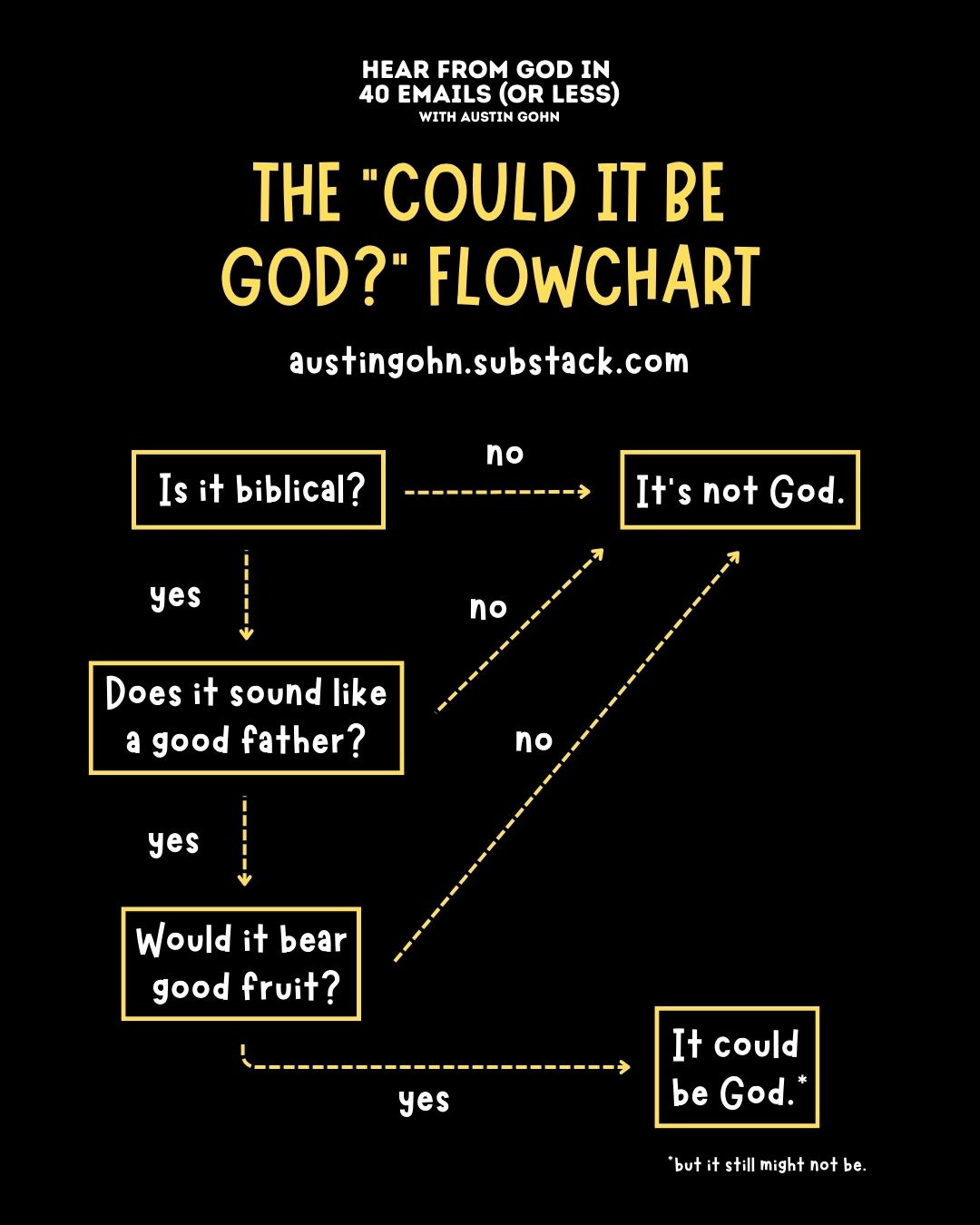
1) Is it Biblical?
“Is it Biblical?” is the single most important question you can ask of any thought or question that pops into your head. Biblical doesn’t always mean “chapter and verse.” It just means that the thought falls within the range of the kinds of things God could say based on what he’s already said to us in the Bible.
If something you’re hearing in your heart is at odds with what God has already spoken, it’s not God. As Hebrews 6:18 says, “It is impossible for God to lie.” That means God doesn’t change or go back on what he’s already said just so you can do what you want to do.
Answering this question effectively, though, requires a deep familiarity with the Bible. The further the Bible gets into your bones, the easier it is to answer whether or not a thought is biblical. If your knowledge of the Bible is still relatively surface-level, you need to consult those with more knowledge than you. (We’ll explore the role of other people in the “A” part of the H.E.A.R. Framework.)
Think of deep familiarity with the Bible as forming a protective atmosphere around your heart. The earth’s atmosphere is one of the reasons we can live here. It burns up many of the things flying through space that are on a collision course with earth. The moon, on the other hand, has an almost non-existent atmosphere and it shows. It’s full of craters. Without a biblical atmosphere around your heart, it’s not long before you’re letting every thought pass through and you end up feeling the impact.
We’ll explore more about how God speaks to us through the Bible in a future series, but for now, it’s sufficient to say, if your answer is no to the question, “Is it biblical?,” your thought is definitely not from God. As Dallas Willard states clearly, “Any voice that does not conform to biblical content is not a word from God.”3
End of story.
One of the problems, of course, with this test on its own is that Satan also quotes the Bible. If Jesus’ experience in the wilderness is any evidence, a literal “chapter and verse” from the Bible could come into your mind, and it might not be God. That’s why you need to answer a few more questions.
2) Does it Sound Like a Good Father?
When determining if a thought is from God or not, it’s not just the content of the thought that matters, it’s the tone.
Priscilla Shirer says, as one of her tests for discerning God’s voice, "You’ll know His voice by its loving, personal tone. So when determining whether or not you’re hearing from God, always consider His ‘Fatherliness.’”4 In an earlier post, we explored how God’s guidance can be compared to how a parent guides us. It’s no surprise that God’s voice should sound like that of a good father.
But, what exactly does a good father sound like?
When God speaks to Job, one of his opening lines is, “Get ready to answer me like a man” (Job 38:3). Other times, God says things like what he says at the baptism of Jesus, “You are my beloved son; with you I am well pleased” (Luke 3:22). It’s a reminder that a good father doesn’t always sound the same.
If you want to know what the Father sounds like, one helpful lens is considering the tone of Jesus’ voice during his earthly ministry. As Jesus himself says, “If you know me, you will also know my father” (John 14:7).
When Jesus spoke, people often described him as one who spoke “with authority” (Matthew 7:29), which is one word that can describe what a good father sounds like. It’s not the only word, though. Jesus also describes himself as “lowly and humble in heart” (Matthew 11:29) or, as some translations say, gentle.5
With that in mind, it can be helpful to use the phrase “gentle authority” to describe the sound of a good father—sometimes with an emphasis on the gentle and other times with an emphasis on the authority, depending on what the situation demands.
If that thought you’re having doesn’t have the tone of a good father, it’s not God.
The problem is that, unlike the first question, this question can be particularly subjective, which is why it’s helpful to ask one more question.
3) Would it Bear Good Fruit?
As one of his tests for God’s voice, Jack Deere always asks about the fruit of the voice, “What does it produce in you?”6
If you were to act on this thought, what would be the results in your life and the lives of those around you? If the first two questions address the content and tone of the thought, the last question considers the results of it.
This requires an exercise of the imagination.
If the thought is from God, it should bear “good fruit” in your life. Jesus often says that a good tree will produce good fruit (Matthew 7:17). Paul writes, “But the fruit of the Spirit is love, joy, peace, patience, kindness, goodness, faithfulness, gentleness, and self-control” (Galatians 5:22-23). If the thought wouldn’t produce more of that in your life and the lives of those around you, you can be confident that it’s not God.
We’ll explore this more in a later post, but one of the ways that Paul tests prophetic words from other people is by whether or not they “build up” those around them. In other words, one of the ways you can know if a prophetic word is from God is by its effect.
It’s not always easy to predict the fruit of a decision in the moment, but sometimes a brief exercise of the imagination can help you at least get a general idea of what could happen.
“Hold on to the Good”
Is it biblical? Does it sound like a good father? Would it bear good fruit?
If you can answer all three questions with yes, is it God? You’re going to be disappointed by this, especially if you’re looking for a one-size fits all formula, but: not necessarily. It could be God, but it still might not be.
None of these tests are foolproof. They come with an asterisk, and that’s okay.
When Paul says, “test all things,” he doesn’t say, “hold on to what’s definitely from God,” he says, “hold on to the good.” If a thought can pass through all three questions, you can hold onto it because you know it’s at least good even if you’re not 100% certain if it’s from God. The other parts of the H.E.A.R. Framework will help you determine if it’s from God. In the end, it’s about holding onto what is good—even if you’re not sure if it’s God, just yet.
Hold onto the good you might be hearing within your heart, but hold it loosely. Write it down in the “H” section of your H.E.A.R. Framework as a possible way that God might be speaking to you.

When I heard, “Let her thrive,” I didn’t know if it was from God or not. What I did know is that it’s biblical to love your spouse by making room for her to thrive. The tone, as best as I can remember, was one of gentle authority. Finally, if I were to act on that thought, I could be confident that it would bear good fruit in my life. Was it definitely a word from God? I don’t know, but I know it was good.
I’d love to hear from you: Are there any other questions you’ve found helpful to ask when trying to discern God’s voice in your heart?
This is email 22 out of 40 in Hear From God in 40 Emails (Or Less)—a Substack series designed to give you biblical and practical guidance on hearing from God in a decision that matters to you. Start with the first email.
Ethan Kross, Chatter.
Jack Deere, Why I Am Still Surprised by the Voice of God, 195.
Dallas Willard, Hearing God, 232.
Priscilla Shirer, Discerning the Voice of God, 104.
Dane Ortlund, Gentle and Lowly, 21. “If we are asked to say only one thing about who Jesus is, we would be honoring Jesus’s own teaching if our answer is, gentle and lowly.”
Jack Deere, Why I Am Still Surprised by the Voice of God, 191ff.
Good post as usual. The challenge I run into in this flow chart is the inability of many people to discern good fruit. Most of the folks who struggle with words from God not coming to pass is the good fruit they are looking for are really their soul's desire and they have never had the spiritual formation to discern their own heart as opposed to the leading of the Spirit.
Not a critique, just furthering the conversation.