
Hear God Like Hudson Taylor
Three lessons for you from how one of the most famous missionaries in history experienced God’s guidance in young adulthood about what he should do with his life.

Long before he would launch China Inland Mission in 1865, recruit hundreds of missionaries to join him, and become one of the most influential missionaries in history, Hudson Taylor was just a relatively normal teenager living in northern England, working as an assistant in his dad’s pharmacy, wondering what he was supposed to do with his life.
If you have been subscribed to this Substack for a while, you might know that I have a particular interest in how people hear God in the decisions in that matter most. In 2025, I wrote a forty email series all about it and introduced a simple tool I use to guide people called the H.E.A.R. Framework—designed to help people pay attention to four of the most common ways God guides people.
After finishing Volume 1 of a two-part biography about Hudson Taylor as part of this quarter’s reading list, all about his early years, I saw an opportunity to do a case study on his experience with hearing God in one of the decisions that matter most. In this post, I’ll tell the story of how he experienced God’s guidance as a young adult, imaginatively work his experience through the H.E.A.R. Framework, and share a few lessons for you as you seek God’s guidance in the decisions that matter most.

Hudson Taylor as a Young Adult Who Wanted to Hear God
From a young age, Hudson Taylor was primed to expect God’s guidance.
His parents, James and Amelia, as part of a long legacy of faith going back generations to the First Great Awakening, were committed to teaching their kids to listen for God’s voice through the Bible and prayer.
Despite his upbringing, though, like many teenagers, he began to lose his childhood hunger for God. By the age of seventeen, he had nearly drifted out of faith completely. His mother, Amelia, much like Saint Augustine’s mother Monica before her and many moms and dads since, was desperately praying for him to come back to faith.
Eventually, he makes “the first conscious surrender of his heart to God” after reading a little book on his dad’s bookshelf about the finished work of Jesus.1 When he shares the news with his mom, who was away at the time, she tells him that she already knew. The Holy Spirit had nudged her to pray for him that same day and, after hours of prayer, revealed to her heart that he had finally surrendered to God.
From that moment on, Hudson Taylor’s spiritual growth was fast-tracked.
One afternoon, he was talking with God and felt the nudge toward setting apart his life to be used by God in some way. He said, “I besought him to give me some work for Him, as an outlet for my love and gratitude; some self-denying service, no matter what it might be, however trying or however trivial; something with which He would be pleased, and that I might do for Him who had done so much for me.” As he’s praying, he sensed in his heart, “For what service I was accepted I knew not. But a deep consciousness that I was not my own took possession of me, which has never since been effaced.”2
He knew that God was going to use him.
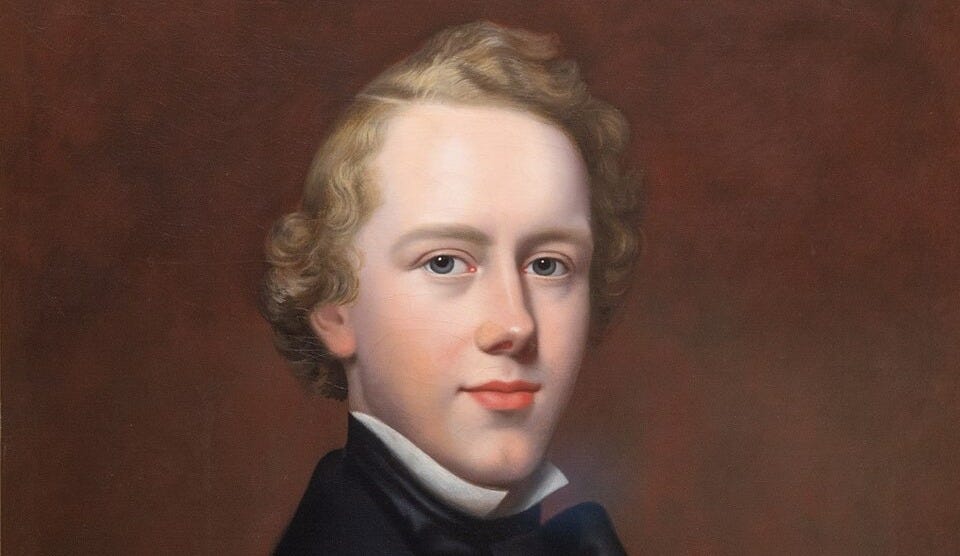
For the rest of 1849, as a teenager whose faith had just come alive, Hudson Taylor’s main prayer to God seemed to be something like: God, I know you want to use me, but how? It wasn’t until a few months later, on December 2, 1849, that he got his initial sense of God’s answer to that question.
At that time, he was praying to God that, if God would just break the power of sin over his life, he’d do anything for him—a prayer that every teenager at Christian summer camp has prayed at some point. As he’s praying, realizing that he may have over-promised God in that moment of spiritual anxiety, he felt a word from God in his heart. Describing it later, “I felt as though I wished to withdraw my promise, but could not. Something seemed to say, ‘Your prayer is answered, your conditions are accepted.’ And from that time the conviction has never left me that I was called to go to China.”3

For the next few years, his question was something like, “Okay, God, I know I’m supposed to go to China as a missionary, but how and when?”
He read up everything he could on China but, for the most part, he experienced both external and internal roadblocks. “For then it was, almost immediately after he had come to know the will of God for his future,” his biographer writes, “that a counter-current set in, as powerful as it was unexpected.”4
After sharing his desire with a pastor, who had a copy of a book on China that he wanted to read, the pastor asked, “And how do you propose you go there?” Hudson Taylor shared his faith that God would supply his needs. And, the unprompted advice he got from this pastor in return was, “Ah, my boy, as you grow older you will become wiser than that.”5 (He said later that he grew older but not wiser.)
His parents were mostly neutral about it—neither particularly discouraging or encouraging.
For a brief moment, he fell in love with someone, but she did not share his interest in moving to China and they broke it off.
He was in his early twenties and nearly three years had passed since he first felt that he was supposed to go to China. In the meantime, he had begun pursuing medical training as something that might open the door for him to do work in China. He was feeling ready to go, but after asking for wisdom from those closest to him, he writes in a letter his mom, “As to my going to China—in accordance with the unanimous advice of those I have consulted here and with your opinion, I intend, D.V., [meaning “God-Willing”] to remain in Hull another year to wait upon the Lord for guidance. I was much pleased with your judgment, as I had prayed to the Lord, to whom all hearts are open, to bring us definitely to one mind. If it be His will for me to go sooner, He can thrust me out or open his promises.”6 He trusted that God was guiding him through the unified opinion of his friends and family.
Eventually, he ended up in London. There was really only one potential open door to China, and it was through a committee called the Chinese Evangelisation Society. But, he was basically red-taped by it—shutting the only open door right in his face. He also got so sick at the time that he almost died. Anyone else might have given up and discerned that God wasn’t guiding him toward China.
Finally, in 1853, nearly four years after he felt he was supposed to go to China, he dropped out of medical school and went all in on the possibility of getting to China. He received a letter from the Chinese Evangelisation Society on June 4, 1853 telling him that they would send him there as soon as he was ready. And, shortly after, he got on a boat and left for China—and it’s just the beginning of a life of listening for God’s guidance whose impact the world still feels today.
How Hudson Taylor Might Have Used the H.E.A.R. Framework
If you subscribe to this Substack, you’ll get a free one-page H.E.A.R. Framework that’s designed to help you discern how God might be guiding you. If Hudson Taylor subscribed this Substack and used this framework, here is a picture of what I imagine it might have looked like:
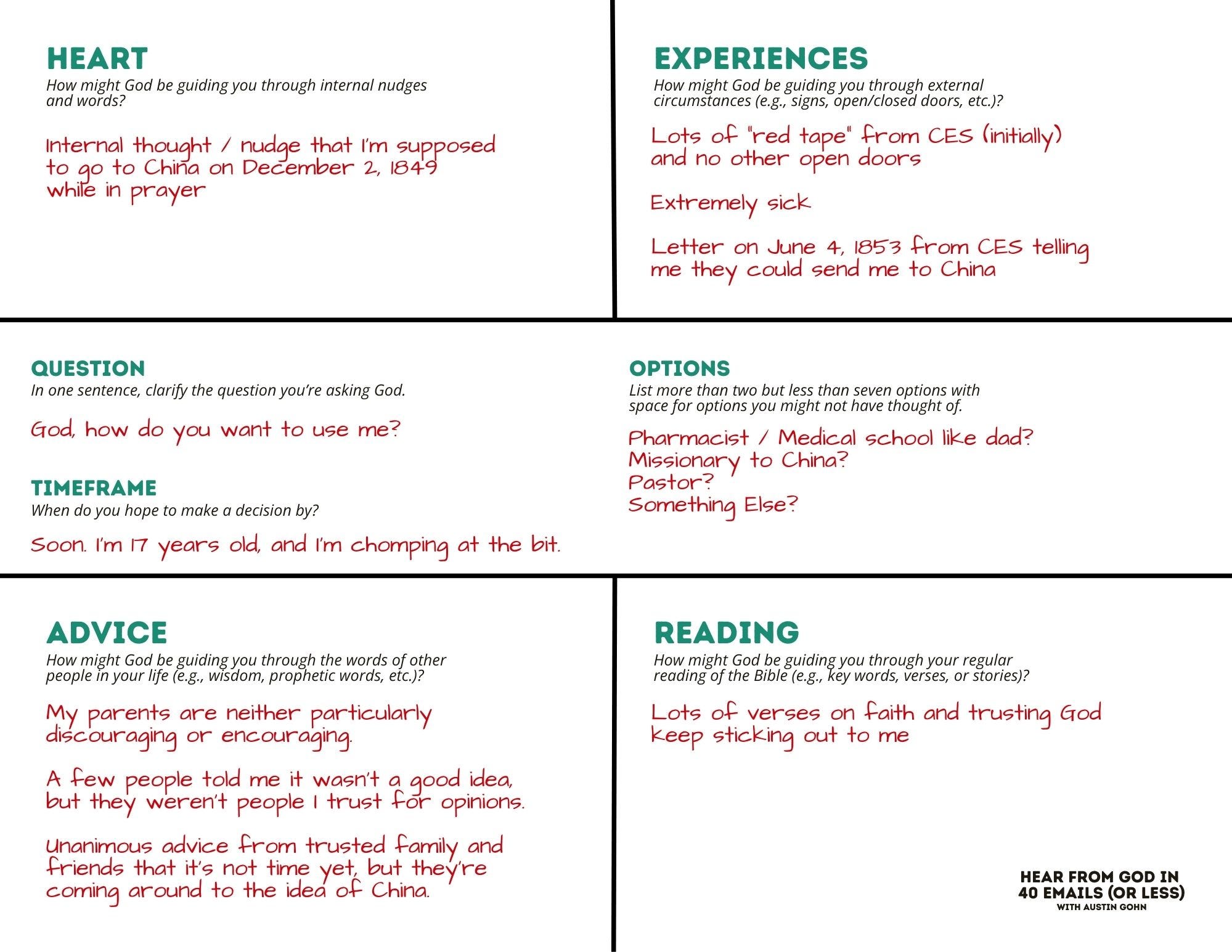
I’ve clearly taken some liberties with this, but it’s probably in the ballpark. For more on the steps in his framework, check out this post on Five Steps That Will Prime You to Hear from God.
Three Lessons from Hudson Taylor for the Next Time You Want God’s Guidance
If you’re ever seeking God’s guidance about one of the decisions that matters most, here are three lessons you can learn from Hudson Taylor’s first experience.
1) Resistance doesn’t mean you’re not hearing from God.
Hudson Taylor felt a clear word from God in his heart that he was called to go to China. For the next three to four years, though, all he experienced was resistance and what felt like “closed doors.” If resistance had been the determining factor in God’s guidance, he might have never gone to China.
As I shared in a post called Three Myths about Open Doors, the path of least resistance is not necessarily God’s will for your life. (Neither is the path of most resistance, for that matter.) Sometimes, there’s this idea that if it’s God’s will, it should be easy, but that’s not always (or even often) the case. Resistance is just one factor among many that has to be held in tension with the other ways that God guides.

2) Not all advice is created equal.
Hudson Taylor experienced “wisdom” from a few people about his sense from God that he was called to go to China. They told him it wasn’t wise and that he didn’t stand a chance. If he had listened to their advice, he might have never gone to China.
On the other hand, when he was feeling restless and ready to go to China as an angsty young adult in medical school, he listened to the unified wisdom of a core group of family and friends—discerning that he needed to wait on God’s guidance for another year. He could have said, “But I’ve heard from the Lord in my heart. Forget you guys.” But, he wisely allowed them to operate as what I’ve called a Hearing God Mastermind for him, and he listened to their opinions.
Even if you sense a word from God in your heart, submit that word to a community of trusted people in your life—remembering that not all advice is created equal.

3) Be careful about timelines.
When I walk people through the H.E.A.R. Framework, I encourage them to write down a timeline for hearing God’s voice. I recommend not making it too short or too long—starting with just forty days if it makes sense to do so.
For Hudson Taylor, within just a few months of asking God for guidance on how God wanted to use him, he had a clear word from the Lord to go to China But, it would be three years before the door actually opened for him to do that. He had to balance both urgency and patience—trusting God’s timing.
Sometimes, you’ll experience God’s guidance about something on a shorter timeline, but there will be a longer timeline between that moment of guidance and actually being able to take the next step. Other times, you’ll get to the end of a discernment timeline and the only sense you’ll have from God is, “Wait, take more time with this decision.”


If you’re interested in reading more on Hudson Taylor, I don’t recommend starting with the two-part biography. Start with the shorter biography about him called J. Hudson Taylor: A Man in Christ by Roger Steer. I read that book in my early twenties after a recommendation from a mentor (and made a book note for it), and it’s what made me fascinated with his life.
If you’re interested in learning more about the H.E.A.R Framework for experiencing God’s guidance in the decisions that matter most, start with the last email in my forty email series. It has a full list of all forty emails and asterisks marking the ten best emails.
I’d love to hear from you: What was helpful to you from Hudson Taylor’s experience of God’s guidance in early adulthood?
Dr. and Mrs. Howard Taylor, Hudson Taylor in Early Years (Volume 1): The Growth of a Soul, 62.
Hudson Taylor in Early Years, 70-71.
Hudson Taylor in Early Years, 78.
Hudson Taylor in Early Years, 94.
Hudson Taylor in Early Years, 85.
Hudson Taylor in Early Years, 143.