
Divine Data & Decision-Making
What might it have looked like if the Apostle Paul used the H.E.A.R. Framework in the middle of his second missionary journey?

When the Apostle Paul and his team were on their second missionary journey, they found themselves at a literal crossroads deep in modern-day Turkey.
Here’s how Luke describes it in the biblical book of Acts:
They went through the region of Phrygia and Galatia; they had been forbidden by the Holy Spirit to speak the word in Asia. When they came to Mysia, they tried to go into Bithynia, but the Spirit of Jesus did not allow them. Passing by Mysia they went down to Troas. During the night Paul had a vision in which a Macedonian man was standing and pleading with him, “Cross over to Macedonia and help us!” After he had seen the vision, we immediately made efforts to set out for Macedonia, concluding that God had called us to preach the gospel to them. (Acts 16:6-10)
Paul and his team are asking God where they should preach the gospel and plant a church next, and they need to figure it out before they reach the end of the road they’re on. As far as we can tell, they have a few options:
They could take a left turn and walk toward the Roman Province of Asia to the southwest—with leading cities like Ephesus.
They could take a right turn and go toward the region of Bithynia to the north.
If they just go straight and follow the road long enough, eventually they would end up in Troas where they could catch a ship to Macedonia across the sea—or just find a nice Airbnb and hang out for a while.

As they’re trying to discern which way to go, in the most literal sense of the word, they experience God’s guidance in a variety of different ways:
We don’t know how, but they were “forbidden by the Holy Spirit” to go to Asia for the moment—maybe, it was a prophetic word from Silas, who we know had a prophetic gift (Acts 15:32).
We also don’t know how, but the “Spirit of Jesus” doesn’t allow them to go to Bithynia—maybe, it was like his previous experience on the road to Damascus in Acts 9, a thought that came into Paul’s mind, or simply some other kind of circumstantial closed door like construction (for all we know).
Then, Paul has a strange dream about a Macedonian begging them to cross the sea that was either from God or something weird he ate.
You could think of all these moments as DIVINE DATA—raw information, most likely from God, that needs to be prayerfully processed as part of making a decision about what to do next.
If you’re in a season of decision-making and you’ve been using something like the H.E.A.R. Framework to listen for God’s guidance, you probably have gathered some DIVINE DATA of your own. But, in the end, you still have to make a decision in light of that data about what you’re going to do next—just like Paul and his team did.
As we’re closing in on the end of Hear from God in 40 Emails (or Less), I’m going to share a spectrum of four questions you can ask to help you make sense of the “divine data” you’ve gathered as you try to discern the next step you’re going to take.
The H.E.A.R. Framework: A Quick Review
The H.E.A.R. Framework is a tool I designed to help you discern how God might be guiding you in the decisions that matter most. I’ve refined it over years of conversations with people in and beyond my church, and I’ve used it to walk many people through decisions about work, relationships, and more. In what follows, I’m going to include lots of links to previous posts in this series that go into more detail.

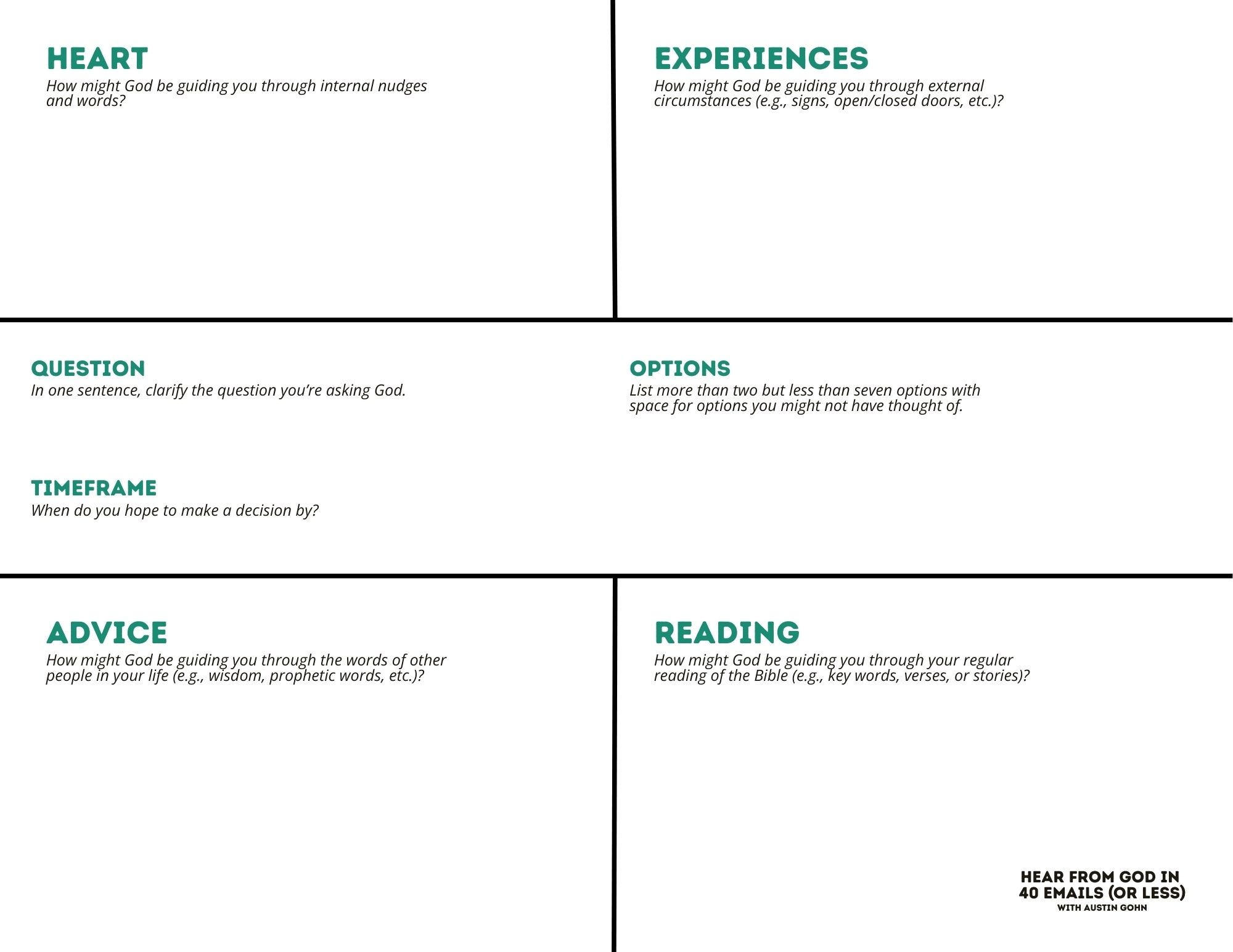
In the middle of the H.E.A.R. Framework, there are three essential steps for you to take before you begin using it—in addition to praying for indifference to anything but God’s will and actually asking God to speak:
Question: In one sentence, clarify the question you’re asking God. Make sure it’s not too big, too vague, too shallow, or too soon.
Timeframe: When do you hope to make a decision? Live somewhere in the tension between too long and too short of a timeframe.
Options: List more than two but less than seven options—with space for options you might not have thought of yet. Avoid false binaries and the paradox of choice.
After these steps, you’re in a position to start paying attention and taking note of four different categories of ways that God might be guiding you: Heart, Experiences, Advice, and Reading. It’s not a formula, and God won’t always guide you through all four ways, but they are helpful categories.
HEART: Make space for monastic moments and take note of how God might be speaking to you through thoughts that come into your mind (see the “Could It Be God?” Flowchart) or gut-level divine nudges.
EXPERIENCES: Keep an eye out for potential signs and open (or closed) doors. Just watch out for cognitive biases like “confirmation bias” and don’t get stuck in the “fleece confirmation spiral.”
ADVICE: Ask some trusted “gray-haired Yodas” for wisdom and make room for the prophetic—even if you don’t consider yourself charismatic. If you want, build your own Hearing God Mastermind.
READING: Keep your Bible open and dig into your Biblical Operating System (OS) for any principles, verses, or anything else from your past reading of the Bible that might be relevant to the decision at hand. See how God speaks through the practice of lectio divina in your normal Bible reading plan as well as the practice of active sermon listening on ordinary Sundays.
What does the H.E.A.R. Framework looks like when it’s filled in? I’ll give you an imaginative sample of what it might have looked like for Paul and what it might have looked for me in a decision I made in the past.
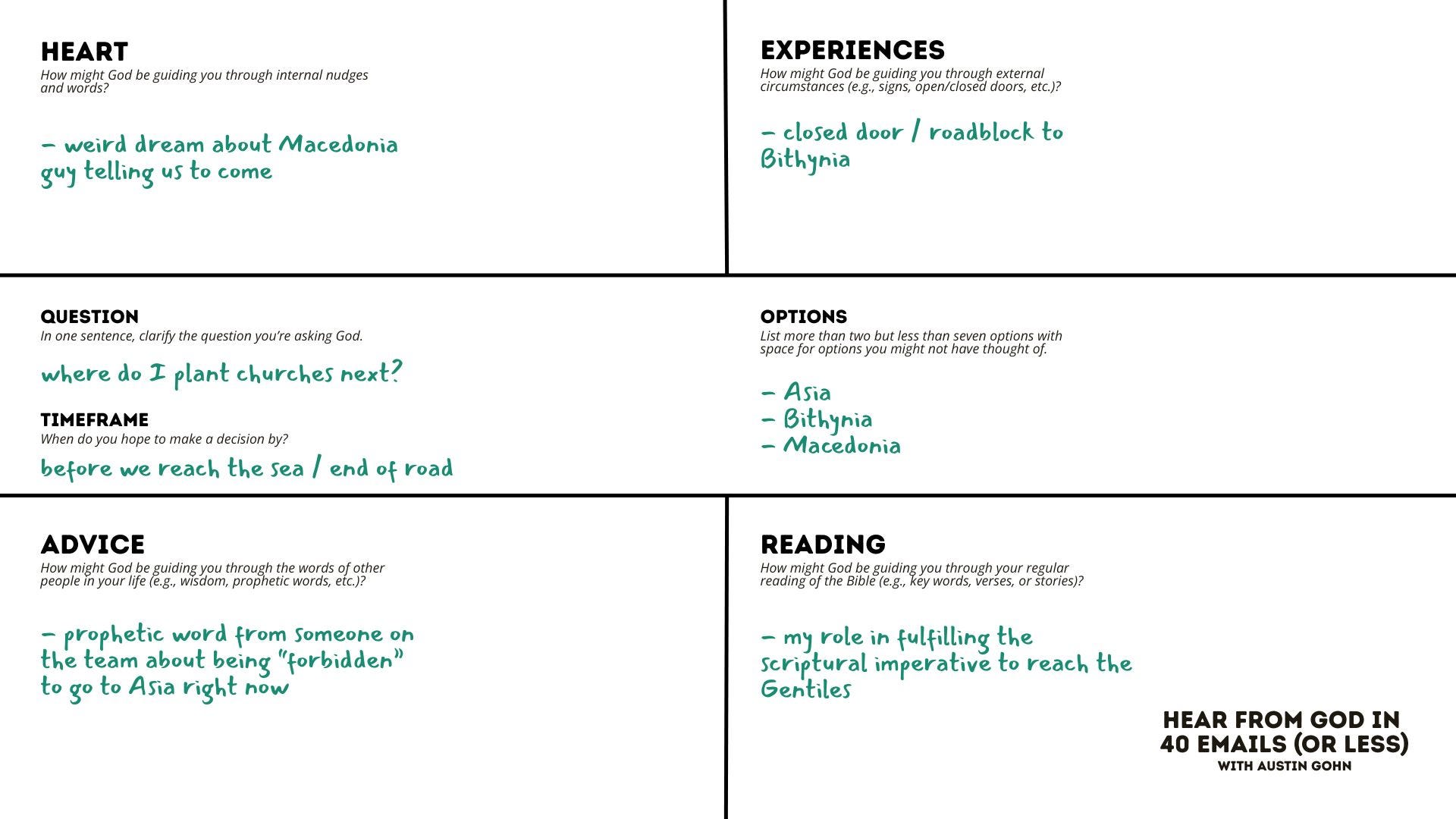
Sample H.E.A.R. Framework 1: Paul and His Team
Let’s imagine for a moment that, in Acts 16:6-10, Paul had been following along with this Substack and had a copy of the H.E.A.R. Framework downloaded to a piece of parchment. Taking a few liberties into account, since we don’t know the details, it could have looked something like this.
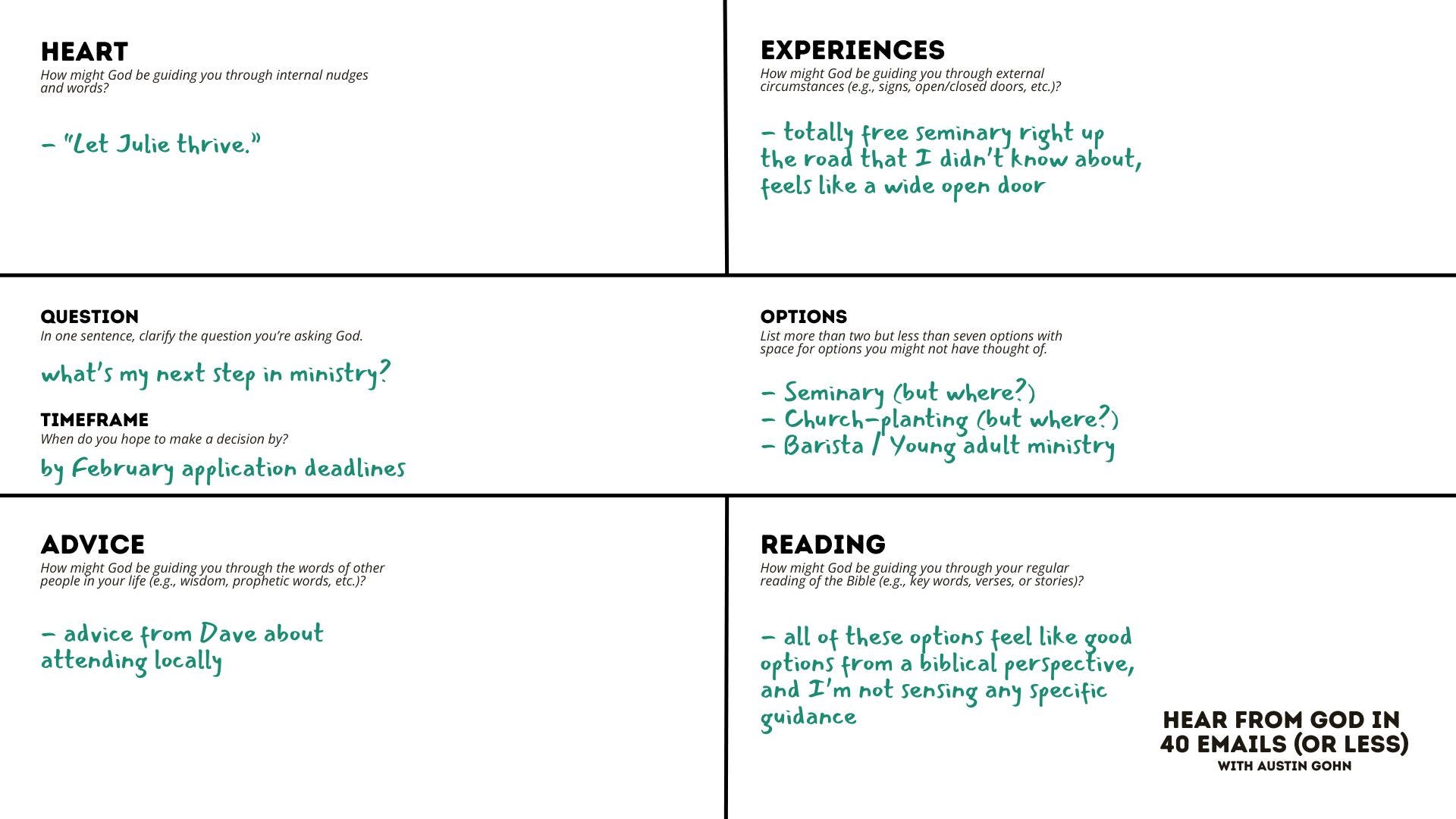
Sample H.E.A.R. Framework: Me
Or, consider one of the stories I’ve told in this series, across a few different emails, about the time that I was trying to decide what to do at a vocational crossroads of my own. I hadn’t developed the H.E.A.R. Framework at that time, but if I were to fill one out now based on what I was experiencing then, it might have looked something like this.
Heck No, Maybe No, Maybe So, Heck Yes
In the end, everything you take note of in your H.E.A.R. Framework is divine data—raw information, no matter how clear or unclear some of it might feel, that still requires prayerful processing by you.
Data is helpful, but it can’t make a decision for you. That’s up to you.
Whether you feel like you received guidance in every one of the four categories or barely any guidance at all (which is normal), it’s still up to you to discern what you are going to do based on the data you have. Paul still had to “conclude” with his team (Acts 16:10) that his next step was into Macedonia, and I still had to discern that it was time for me to go to seminary. Even after hearing God’s voice from a burning bush, Moses still had to discern if he wasn’t losing his mind and that he really should go back to Egypt.
As you’re closing out a season of listening for God’s voice about a decision you’re facing, I encourage you to set aside some extra time to prayerfully discern which of your options God might be pointing you toward—or, at the very least, which options he might be pushing you away from.
Here is a spectrum of four questions you can consider as you’re trying to discern your next step to take among multiple options—including options that weren’t on the table when you started the process:
Which of my options, if any, seem like a “heck no”? They might be options that lie behind a closed door. They might be options that some wise people in your life told you weren’t a good idea no matter how good your intentions might be. They might even be options that the Bible clearly prohibits. Just cross those out and kiss them goodbye.
Which of my options, if any, seem like a “likely no”? The door might not be totally closed on these options, but at a gut-level, they just don’t feel like the right way to go—or, at the very least, not yet.
Which of my options, if any, seem like a “maybe so”? These still feel like good options that are within the realm of possibility. The doors are still open, but you haven’t heard anything one way or the other about them. These options are still on the table. In many decisions, you will discover that there might be a few good roads you could take within God’s will.
Which of my options, if any, seem like a “heck yes”? Sometimes, even when confirmation bias is taken into account, it feels like all the data is pointing in one direction. It might not be 100% clear, but to do anything else feels like you would be “kicking against the goads” (Acts 26:14)—to use a first-century idiom that I’m sure you can relate to.
If you’re facing a decision right now and you’ve worked through the H.E.A.R. Framework, which option are you discerning is next for you based on the divine data you have available?
Maybe, you had to scratch all your options because none of them seem within God’s will for you and you’re back to the drawing board. Or, maybe you ended up with one option that God seems to be elevating above the rest. Often, you end up with multiple good options and you just have to choose one.
But, you might be thinking, “What if I’m still not 100% clear about my next step?” If that’s you, you’re just like everyone else I’ve ever walked through this process with, and you’re just like me. In my next email, I’m going to share the game-changing story I first read as a college student that made me realize that clarity was never the goal.
I’d love to hear from you: Have you been using the H.E.A.R. Framework with a decision in your own life, and how has it helped you discern your next step?
This is email 36 out of 40 in Hear from God in 40 Emails (or Less)—a Substack series designed to give you biblical and practical guidance on hearing from God in a decision that matters to you. Read this email for how to get caught up in just seven emails.